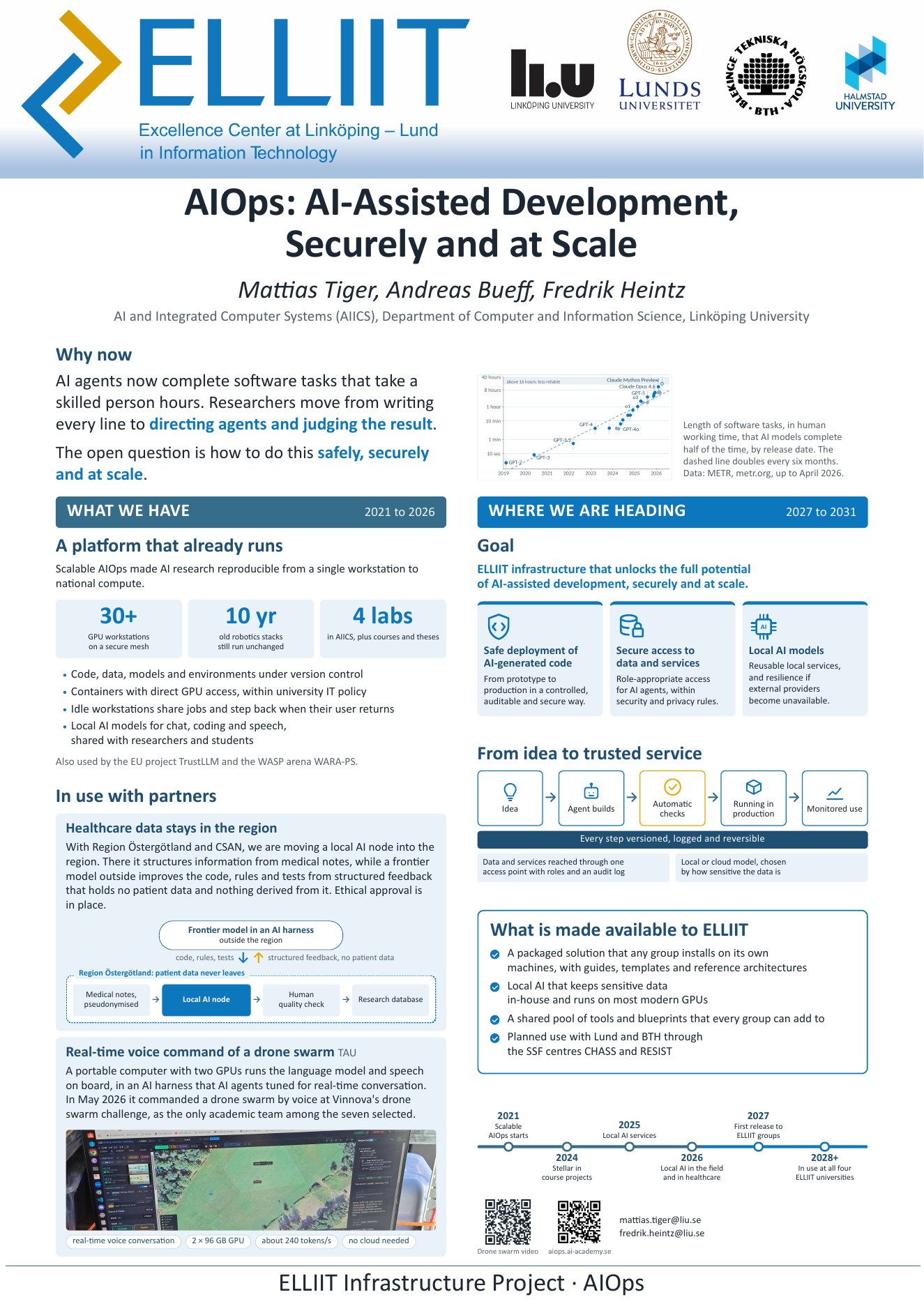
AI agents now complete software tasks that take a skilled person hours. Researchers move from writing every line to directing agents and judging the result. The open question is how to do this safely, securely and at scale.
Posters
What we have
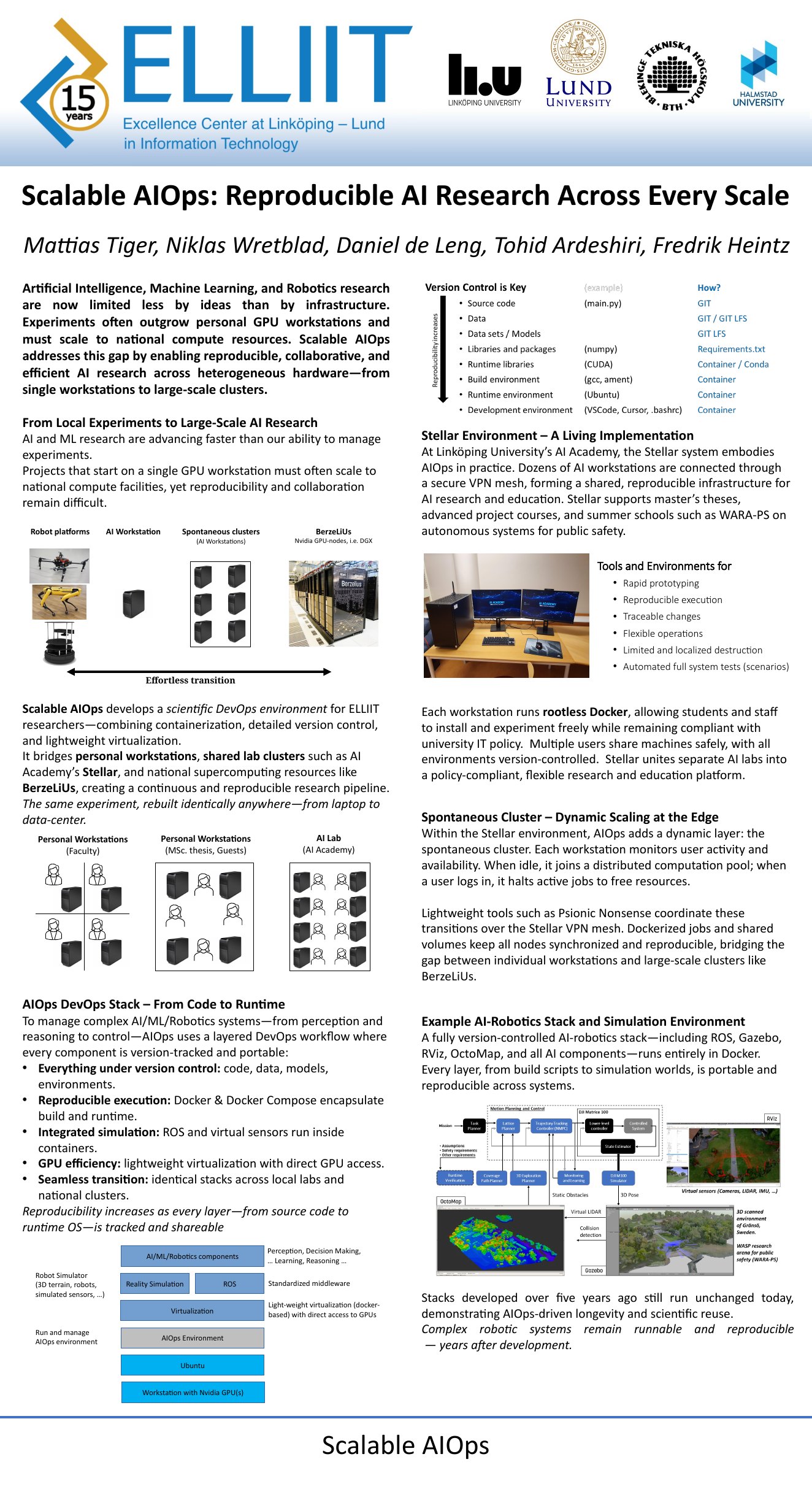
Scalable AIOps made AI research reproducible from a single workstation to national compute.
- 30+ GPU workstations on a secure mesh, in four AIICS labs, plus courses and theses
- Code, data, models and environments under version control
- Containers with direct GPU access, within university IT policy
- Local AI models for chat, coding and speech, shared with researchers and students
- Also used by the EU project TrustLLM and the WASP arena WARA‑PS
Where we are heading
ELLIIT infrastructure that unlocks the full potential of AI‑assisted development, securely and at scale.
- Safe deployment of AI-generated code, from prototype to production in a controlled, auditable and secure way
- Secure access to data and services, with role-appropriate access for AI agents
- Local AI models as reusable services, and resilience if external providers become unavailable
What is made available to ELLIIT
- A packaged solution that any group installs on its own machines, with guides, templates and reference architectures
- Local AI that keeps sensitive data in‑house and runs on most modern GPUs
- A shared pool of tools and blueprints that every group can add to
In use with partners
Healthcare data stays in the region. With Region Östergötland and CSAN, we are moving a local AI node into the region. There it structures information from medical notes, while a frontier model outside improves the code, rules and tests from structured feedback that holds no patient data and nothing derived from it.
Real-time voice command of a drone swarm. A portable computer with two GPUs runs the language model and speech on board. In May 2026 it commanded a drone swarm by voice at Vinnova's drone swarm challenge. Video
Code
Links to the project's repositories on gitlab.liu.se will appear here.